Home › Anti-Aging & HGH › GenF20 Plus Review
Study investigationGenF20 Plus Review: The Trial Missed Its Main Goal. The “28%” Came From a Subgroup Picked Afterwards.
GenF20 Plus sells on one number: a 28% rise in IGF-1, the blood marker used as a proxy for growth hormone. We read the published trial from start to finish, compared the tested regimen with what you actually get in the box, and priced the full system. The paper tells a very different story from the sales page.
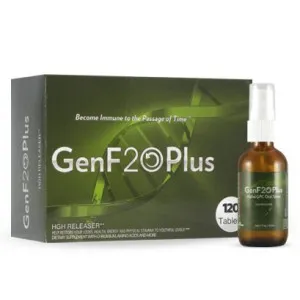
A real published trial that didn’t beat placebo on its main outcome — and the regimen it tested included an oral spray that’s sold separately, which pushes the real cost to around $4 a day.
- Main result: not significant
- “28%” = post-hoc subgroup
- 4 tablets a day
- Spray sold separately
- 67-day refund window
✓ Checked 14 October 2026 — single-box and spray prices and refund terms checked on the manufacturer’s store; trial data taken from the full published paper.
The short version
GenF20 Plus deserves credit for one thing: it was tested in a randomised, placebo-controlled trial, and the results were published in a peer-reviewed journal. Most “HGH releasers” have nothing like that. The problem is what the trial found. On its primary outcome — the change in IGF-1 levels — GenF20 Plus did not beat the placebo by a statistically significant margin. The study’s own authors wrote that the product “may not have delivered the projected efficacy results”.
The 28% figure on the sales page comes from a later analysis of only the participants aged 40 and over, after a statistical adjustment. That’s a legitimate thing for researchers to explore, but it’s a lead for future research, not proof. Nothing else measured — body fat, muscle, memory, libido, energy or sleep — differed from placebo. And the participants took tablets and an oral liquid together, while the manufacturer sells the spray as a separate add-on.
What holds up
- Published, placebo-controlled trial of the product
- Run by a contract research organisation, published openly
- Tablet ingredients and most doses disclosed
- No serious side effects in 12 weeks
- 67-day refund window from an established seller
What doesn’t
- Primary outcome not significantly better than placebo
- “28%” comes from a post-hoc, adjusted subgroup
- No body-composition or symptom benefit vs. placebo
- Tested regimen needs a separately sold spray
- Spray doses not disclosed; “reverse aging” claims overreach
GenF20 Plus at a glance
What we checked
- ✓Published trial. Sonawane et al., Open Access Journal of Clinical Trials, 2015 (DOI 10.2147/OAJCT.S75969) — 70 adults aged 35–65, 12 weeks, five centres.
- ✕Primary outcome. IGF-1 rose 13.46 ng/mL on GenF20 Plus vs. 6.35 ng/mL on placebo — not statistically significant.
- ✕The 28% claim. A post-hoc analysis of over-40s, significant only after adjusting for differing baseline IGF-1.
- !What was tested. Tablets plus an oral liquid, twice daily. The spray is sold separately and its doses aren’t published.
- !Guarantee. 67 days from delivery, first two opened containers plus unopened ones, shipping excluded, one refund per customer.
- ✕Marketing claims. “Clinically proven to reverse the signs of aging” and “look and feel up to 10 years younger” aren’t supported by the trial.
The trial: what it actually showed
Seventy adults aged 35 to 65, each with at least two age-related complaints such as poor memory, low libido, low energy or poor sleep, were randomly assigned to GenF20 Plus or a matching placebo for 12 weeks at five centres in India. Sixty-one completed the study. Participants took two tablets with water plus 2 ml of an oral liquid under the tongue, morning and evening, before meals.
The primary outcome was serum IGF-1 — not growth hormone itself, but a liver-made hormone whose levels track growth-hormone activity. The sales page’s own footnote admits the study “did not measure for a direct increase in HGH”.
The primary result. IGF-1 rose by an average of 13.46 ng/mL in the GenF20 Plus group and 6.35 ng/mL in the placebo group. The authors described the increase as “neither clinically nor statistically significant”.
Source: Sonawane et al. Open Access Journal of Clinical Trials, 2015. DOI 10.2147/OAJCT.S75969.
Average IGF-1 change in ng/mL after 12 weeks, all completers. Scale drawn to 20 ng/mL. The difference between groups was not statistically significant.
Where the 28% comes from
After the main results were in, the researchers split participants by age — what the paper calls a “post hoc” analysis. Among those aged 40 and over, the raw difference still wasn’t significant: IGF-1 rose by 14.59 ng/mL on GenF20 Plus versus 3.17 ng/mL on placebo. Because the two subgroups started with different IGF-1 levels, the authors then applied a statistical adjustment for baseline. After that adjustment, the change was 28.57% in the GenF20 Plus group versus −0.55% on placebo. That adjusted subgroup number is the “28%” in the marketing.
It’s not a meaningless finding. It’s plausible that older adults, who usually have lower IGF-1, have more room to respond. But when you slice a study after the fact, you increase the chance of finding a “significant” result by luck. That’s why researchers treat post-hoc findings as hypotheses to test in a new trial. The authors themselves called for larger, longer studies. We didn’t find one.
Everything else: no difference from placebo
- Body composition: waist size, BMI, body fat and lean muscle didn’t differ significantly between groups.
- Symptoms: memory, libido, energy and sleep scores improved — but in the placebo group too, with no significant difference.
- Satisfaction: 67.7% of GenF20 Plus users rated it positively, versus 60% on placebo — again not significant.
The paper also notes there was no formal sample-size calculation; the authors describe it as an exploratory first study. It was run by Vedic Lifesciences and financed by a sponsor connected to the product; the manufacturer’s own page says the study was commissioned by Leading Edge Health.
What was tested vs. what you buy
This is the practical gap most buyers miss. The trial tested a two-part regimen: tablets plus an oral liquid. On the manufacturer’s store, the tablets and the spray are listed as separate products, and the spray is offered as an add-on. If you buy only the tablets, you’re buying half of what was tested.
| Trial regimen | Tablets only | Full system | |
|---|---|---|---|
| Tablets per day | 4 (2 twice daily) | 4 (2 twice daily) | 4 (2 twice daily) |
| Oral liquid / spray | 2 ml twice daily | None | 6 sprays daily |
| Spray doses published? | In the paper | — | No |
| Matches the trial? | — | No | Closest, not identical |
Tablet directions from the package label; spray directions from the manufacturer’s spray page. The trial used a measured liquid, not a spray, so even the full system isn’t an exact match.
What’s in it
The trial paper lists the tested formula. The tablets contain a blend of amino acids, glandular and animal-derived powders, and herbs. The manufacturer publishes milligram amounts for most tablet ingredients; it doesn’t publish the spray’s doses at all.
IV arginine provokes GH release in tests; oral doses this size are far weaker.
A related blend raised GH in one study — but that blend also contained niacin, which isn’t here.
Amino acids marketed as GH “releasers”; evidence is mostly from injected or very high doses.
Studies using 20 g a day found no reliable IGF-1 rise. A capsule-sized amount is far smaller.
Animal glandular extract; we found no independent human evidence for it.
Marketed for growth factors, which digestion breaks down.
Added for libido; recent reviews find no robust testosterone effect.
Supporting extras with little direct IGF-1 evidence.
Trace mineral; included for blood-sugar support.
Alpha-GPC (~1,000 mg) and Mucuna’s L-dopa can affect GH in studies — but the spray’s amounts are unknown.
Two things stand out. First, the ingredients with the best GH evidence — alpha-GPC and Mucuna — are in the spray, whose doses are secret. Second, several tablet ingredients are animal-derived (colostrum, pituitary powder, deer antler), which some buyers will want to avoid.
Marketing claims vs. the evidence
| What the site says | What we found |
|---|---|
| “Increased IGF-1 by 28% in 12 weeks” | Only in an adjusted, after-the-fact analysis of over-40s. The main result wasn’t significant. |
| “Clinically proven to reverse the signs of aging” | No significant difference from placebo on body fat, muscle, memory, libido, energy or sleep. |
| “Look and feel up to 10 years younger” | Not measured in the trial. |
| “Zero known negative side effects” | The trial recorded mild side effects in both groups. “Zero” isn’t accurate. |
| Arginine can “as much as triple your HGH levels” | Refers to arginine research, often intravenous, not to GenF20 Plus. |
| Injectable HGH costs “$10,000 to $30,000+ per year” | A comparison to a prescription drug with a completely different evidence base. |
Price: what the tested regimen really costs
We confirmed the single-box tablet price ($69.95) and the spray price ($49.95 a bottle) on the manufacturer’s store on 14 October 2026. The 3- and 6-box totals below are the official cart prices reported in recent independent checks; the store page we viewed didn’t display them. Each box holds 120 tablets, a 30-day supply at four a day. The “full system” line adds one spray bottle per month at the single-bottle price.
Spray costs assume one bottle per month at $49.95; multi-bottle spray bundles may be cheaper. Free shipping covers the lower 48 US states only. Confirm all prices in the cart.
If you’re going to try it, buy 3 boxes plus the spray. That covers the trial’s 12-week length with the regimen closest to what was tested, and it fits the refund rules. Buying tablets alone saves money but means you’re taking something that wasn’t studied. And six boxes is a lot to commit when the trial’s main result was a miss.
The guarantee, line by line
The store describes the offer as “risk free for 67 days”. The detail: you try the products for 60 days and return them so they reach the warehouse within 67 days of delivery. Unopened containers, plus your first two opened containers, are refundable. Shipping isn’t refunded, and refunds are limited to one order per customer.
| You buy | Opened containers refunded | Must be unopened | Realistic outcome |
|---|---|---|---|
| 1 box + 1 spray | 2 | — | Fully covered, but only 30 days of use. |
| 3 boxes | 2 | 1 | Two months of tablets covered, third box returned sealed. |
| 3 boxes + 3 sprays | 2 | 4 | The two-opened limit counts containers, so opening a box and a spray uses both. |
| 6 boxes | 2 | 4 | Only covered if you stop after two boxes. |
The spray row is the one to watch. If spray bottles count as containers — and the terms give no reason to think they don’t — then running the full system for a month uses up both of your “opened” refunds. Ask customer support how they count it before you buy a large order.
How to claim the refund without problems. Keep your order confirmation and every empty container. Contact support for return instructions before posting anything, ship with tracking, and send it early — the package has to arrive within 67 days, not just leave.
Side effects and who should be careful
In the trial there were 12 adverse events — seven on GenF20 Plus and five on placebo — mostly mild digestive complaints such as acidity. None were serious. That’s reassuring for healthy adults over 12 weeks, but the study excluded many groups, so its safety data doesn’t cover them.
Don’t take GenF20 Plus without a doctor’s advice if you:
- Have a milk allergy. The tablets contain bovine colostrum.
- Have had cancer, particularly hormone-sensitive cancer. IGF-1 is studied in relation to cancer growth, and the trial excluded these patients.
- Have diabetes, high blood pressure, thyroid, heart, liver or kidney disease. All were excluded from the trial.
- Take Parkinson’s medication or MAO inhibitors, given the L-dopa from Mucuna in the spray.
- Avoid animal-derived products for dietary or personal reasons.
“Anti-aging” symptoms have ordinary causes. Poor sleep, low energy, weight gain and low libido are often linked to sleep quality, thyroid function, vitamin D, testosterone or medication. A check-up and basic blood tests will tell you more than an IGF-1 supplement.
Who should buy it — and who should skip it
It might make sense if you…
- Are over 40 and want to try the one HGH-style product with a published trial, knowing its strongest finding is a subgroup result.
- Are willing to buy the spray as well, to match the tested regimen.
- Can measure your own IGF-1 before and after, so you’re not relying on how you feel.
Skip it if you…
- Want something proven to change body fat, muscle, sleep or energy. The trial didn’t show that.
- Want the tablets only — that’s not what was tested.
- Have any of the conditions the trial excluded.
- Would rather spend $4 a day on things with stronger evidence for the same goals: sleep, resistance training and protein.
What we’d want the seller to publish
- The spray’s ingredient doses, since the best-evidenced ingredients are in it.
- A confirmatory trial in adults over 40, with IGF-1 as the pre-planned primary outcome.
- Clear bundle pricing for tablets plus spray, and how containers count toward the refund.
- Marketing that matches the paper — drop “clinically proven to reverse aging” and “zero side effects”.
- A current third-party certificate of analysis for the tablets and the spray.
How to check any supplement yourself
- Find the primary outcome. It’s stated in the methods. If the headline number isn’t it, ask why.
- Look for “post hoc” or “subgroup”. Those results are leads, not proof.
- Check that you’re buying what was tested — every part, at the same dose.
- Count containers against the refund rules, especially for multi-part systems.
- Price the full regimen per day, add-ons included.
How it compares with the others we’ve reviewed
VigRX Plus and Semenax, from the same manufacturer, both hit their primary outcomes in their trials. GenF20 Plus didn’t, which is the main reason it scores lower despite having a published study.
Frequently asked questions
Does GenF20 Plus actually work?
In its published trial, the increase in IGF-1 wasn’t significantly different from placebo. A significant 28% rise appeared only in an adjusted, after-the-fact analysis of participants aged 40 and over. No body-composition or symptom measure beat placebo.
Does GenF20 Plus increase HGH?
The trial measured IGF-1, not growth hormone. The manufacturer’s own footnote says the study “did not measure for a direct increase in HGH”.
Do I need the GenF20 Plus spray?
To match what was tested, yes — trial participants took tablets plus an oral liquid. The spray is sold separately for $49.95 a bottle, and its doses aren’t published.
How do you take GenF20 Plus?
Two tablets about an hour before lunch and two about an hour before dinner. The spray page recommends six sprays a day alongside the tablets.
How much does GenF20 Plus cost?
Tablets are $69.95 for one box, about $199.95 for three and $349.95 for six. With a spray bottle each month, the full system costs roughly $3.61 to $4.00 a day.
Does GenF20 Plus have side effects?
The trial reported mostly mild digestive complaints, in both the product and placebo groups. People with milk allergy, cancer history or several chronic conditions were excluded, so it isn’t known to be safe for them.
Is GenF20 Plus FDA approved?
No. Dietary supplements aren’t approved by the FDA before sale. Treat any site claiming “FDA approved” with suspicion.
Is the GenF20 Plus guarantee real?
Yes, with limits: returns must arrive within 67 days of delivery, only your first two opened containers are refundable, shipping isn’t refunded and it’s one refund per customer.
Affiliate note: if you buy through this link we may earn a commission. You pay the same price, and it doesn’t change our score. Full disclosure.
